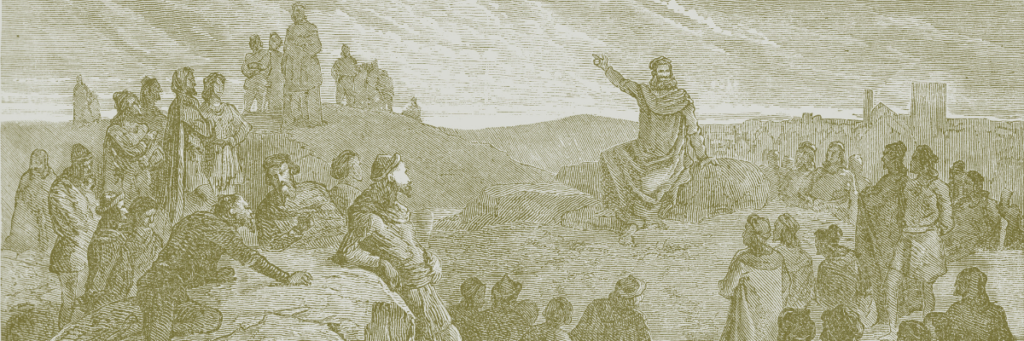
The “Life-Fire” of God’s Word—Charles H. Spurgeon (1834-1892)

In 1854, at the age of twenty and just four years after his conversion, Charles H. Spurgeon became pastor of London’s New Park Street Church. His ministry so grew that the 6,000-seat Metropolitan Tabernacle was built to accommodate the congregation. In “The Mustard Seed: A Sermon for the Sabbath-School Teacher,” he spoke of the power of the gospel, and his words extended to the whole of Scripture.

The human can never rival the divine, for it lacks the life-fire. It is better to preach five words of God’s Word than five million words of man’s wisdom. Men’s words may seem to be the wiser and more attractive, but there is no heavenly life in them. Within God’s Word, however simple it may be, there dwells an omnipotence like that of God, from whose lips it came.1

———————————————-
1 C. H. Spurgeon, “The Mustard Seed: A Sermon for the Sabbath-School Teacher,” The Parables of Our Lord (Grand Rapids, MI: Baker Book House, 2003), 707.


Biblical Insight: Chewing on the Text

This Book of the Law shall not depart from your mouth, but you shall meditate on it day and night, so that you may be careful to do according to all that is written in it. For then you will make your way prosperous, and then you will have good success.

Joshua 1:8 (ESV)

An increasing number of psychotherapists recommend a Buddhist meditation technique. The practice is called “mindfulness meditation,” through which therapists help clients solve emotional issues by instructing them “to foster an awareness of every sensation as it unfolds in the moment.”1 Yoga continues to gain popularity as well, with its goal of “highest Joy that comes from the Realization in direct experience of the center of consciousness.”2 Then there is New Age meditation, which takes strategies from Eastern philosophy, yoga, mysticism, and Buddhism for spiritual and ethical guidance. The range of contemporary “meditation” options can easily cloud the understanding and application of meditation as a Christian spiritual discipline.

Joshua 1 marks a key turning point in Israel’s history. Moses, their longtime leader, has died, and God transfers the role to Joshua. The covenant promises given to the patriarchs are beginning to flower, as the nation is poised on the brink the Promised Land (1:11). Before this momentous event, however, the Lord commissions Joshua and gives him several commands. Central to these imperatives for the new leader is the command concerning the Book of the Law.

The imperatives “shall not depart” and “shall meditate” form the backbone of verse 8. To modern sensibilities, it seems odd that the Lord would focus on the mouth instead of the eye (to read), but in the Ancient Near East, reading was commonly done aloud. This could help to explain why the book was not to depart from Joshua’s mouth.

Meditation essentially means a slow, intentional “chewing” on the text. In fact, the term “meditate” denotes something like mumbling or speaking under the breath. This can be seen today in rabbinic practice. Whether in private or at the Wailing Wall in Jerusalem, many Jews mouth the words of Scripture quietly.

God does not command the new leader to meditate for mere scholarly purposes; instead, He binds meditation with ethical living. “…so that you may be careful to do according to all that is written in it.” Psalm 1 paints the same picture: the blessed man is the one who meditates “day and night” rather than walking in the way of sinners.

Meditation is not meant to be a mindless escape from reality or reflection on one’s own problems. Instead, Christian meditation always focuses on God and His Word for the purpose of holiness and obedience. A believer pauses with God’s Word open before his heart and his mind, prayerfully seeking to understand and apply the Lord’s directions. For meditation to be effective, the mind must be full of God’s inerrant Word, not man’s mere thoughts or yearnings. Indeed, this practice marks the believer “day and night,” leading to holiness and Christlikeness.

—————————————————
1 Benedict Carey, “Lotus Therapy,” New York Times Website, May 27, 2008, http://www.nytimes.com/2008/05/27/health/research/27budd.html?ex=1369627200&en=243cf577038c27b1&ei=5124&partner=permalink&exprod=permalink (accessed June 8, 2010).
2 “The Joy of Traditional Yoga Meditation, Contemplation, and Devotion,” Traditional Yoga and Meditation of the Himalayan Masters Website, http://www.swamij.com/ (accessed June 8, 2010).


How to Start Reading the Bible

Q: My New Year’s resolution is to start reading the Bible, but I don’t know where to begin. Can you help me?

A: There is no wrong place to start reading the Bible. The book of 2 Timothy says that “all Scripture is breathed out by God and profitable for teaching, for reproof, for correction, and for training in righteousness” (2 Timothy 3:16). While the Apostle Paul wrote those words specifically about the Old Testament, they apply to the New Testament as well. Regardless of where you begin reading, God guarantees that the words on the page are true, sent from Him, and powerful to change your life.

Still, different Bible reading plans are better suited for different people. So here are a few methods to consider as you launch into the new year.

  • Read through the entire Bible in a year using a reading calendar. You can find many plans online for covering every single verse in one year. Here is one popular reading calendar by nineteenth-century Scottish minister Robert Murray M’Cheyne, which has you read the Old and New Testaments each day. Here are some other popular reading plans.
  • To read at a slower pace, use a one-year plan but only read half of the assignment each day. This helps some people understand and apply what they read more effectively. And it will take you through the Bible in two years.
  • Start in one of the Gospels (Matthew, Mark, Luke, or John) and read a chapter each day. These books tell the story of Jesus’ life on earth and are a great place to learn about following Him.
  • Start at the beginning. Begin with Genesis, the first book of the Bible, and read Scripture in the order it is presented. Go at your own pace.
  • Have the Bible emailed to you. With this resource from Bible Gateway, you can have daily Bible readings sent directly to your inbox. Without having to tote around a hard copy, it allows you to read through either the New Testament or the entire Bible in a year.
  • Use a chronological Bible to read Scripture in the order it occurred. Though standard Bibles are roughly chronological, some events happened in a different order than they are presented. For instance, the events in 1 Chronicles happened before the events in 2 Kings even though standard Bibles place 2 Kings first. A chronological Bible helps you understand the timing of Scripture’s storyline.

Beyond these, there are many other ways to approach the Bible—some of which you should be able to discover by a quick Internet search. Any of them will help you experience the blessings that come from studying the greatest book ever written. In 2012, may it be a lamp to your feet and a light to your path (Psalm 119:105).

No “Spiritual Gains without Pains”—J. C. Ryle (1816-1900)

J. C. Ryle was a prominent evangelical leader in the Church of England during the second half of the 19th century. A champion of orthodox doctrine in an age of theological decline, he never divorced dogma from holy living. In fact, his book Holiness, from which this excerpt is taken, argued that no true Christian lacks practical godliness. And developing godliness requires practicing the spiritual disciplines.

Sanctification, again, is a thing which depends greatly on a diligent use of scriptural means. When I speak of “means,” I have in view Bible-reading, private prayer, regular attendance on public worship, regular hearing of God’s Word, and regular reception of the Lord’s Supper. I lay it down as a simple matter of fact, that no one who is careless about such things must ever expect to make much progress in sanctification. I can find no record of any eminent saint who ever neglected them. They are appointed channels through which the Holy Spirit conveys fresh supplies of grace to the soul, and strengthens the work which He has begun in the inward man. Let men call this legal doctrine if they please, but I will never shrink from declaring my belief that there are no “spiritual gains without pains.” I should as soon expect a farmer to prosper in business who contented himself with sowing his fields and never looking at them till harvest, as expect a believer to attain much holiness who was not diligent about his Bible-reading, his prayers, and the use of his Sundays. Our God is a God who works by means, and He will never bless the soul of that man who pretends to be so high and spiritual that he can get on without them.1

—————————————————–
1 J. C. Ryle, Holiness: It’s Nature, Hindrances, Difficulties, and Roots, rev. ed. (Moscow, ID: Charles Nolan, 2001), 25.

Real Christianity—John Venn (1759-1813)

William Wilberforce is famous not only for his persistent efforts to see the slave trade abolished in England, but as the author of Real Christianity,1 in which he makes the radical distinction between nominal and real Christians.

Less well-known is the fact that Wilberforce regularly heard this distinction made in the sermons of his pastor and colleague, John Venn, rector of the Clapham Church and Chaplain of the so-called Clapham Sect.

In this excerpt from one of John Venn’s sermons, real Christianity is distinguished from nominal Christianity in vivid terms:

Religion is not merely an act of homage paid upon our bended knees to God; it is not confined to the closet and the church, nor is it restrained to the hours of the sabbath; it is a general principle extending to a man’s whole conduct in every transaction and in every place. I know no mistake which is more dangerous than that which lays down devotional feelings alone as the test of true religion . . . Let us be convinced that all prayer, all preaching, all knowledge, are but means to attain a superior end; and that end the sanctification of the heart and of all the principles on which we are daily acting. Till our Christianity appears in our conversation, in our business, in our pleasures, in the aims and objects of our life, we have not attained a conformity to the image of our Saviour, nor have we learned His Gospel aright.2

—————————————————-

1 The full title is A Practical View of the Prevailing Religious System of Professed Christians in the Higher and Middle Classes of this Country Contrasted with Real Christianity.
2 John Venn, Sermons, vol. 2, 238-239, quoted in Michael Hennell, John Venn and the Clapham Sect (London: Lutterworth Press, 1958), 205.

“Laziness Never Leads to Godliness”—Donald Whitney

While serving as a pastor in the Chicago area, Donald Whitney completed the doctor of ministry degree at Trinity Evangelical Divinity School and penned Spiritual Disciplines for the Christian Life, which was widely distributed by both the Billy Graham Evangelistic Association and Promise Keepers. Since then, he has authored five other books, with forewords from such evangelical leaders as J. I. Packer, John MacArthur, and James Montgomery Boice.

In recent years, Whitney has been a professor of biblical spirituality at Midwestern Baptist Theological Seminary in Kansas City, Missouri, and at The Southern Baptist Theological Seminary in Louisville, Kentucky, where he now serves. As his web site, www.biblicalspirituality.org, reveals, he has an extensive speaking and writing ministry, and as the following selection from his first book indicates, he makes no apology for his crowded schedule. He argues that a serious Christian is typically a busy Christian.

I’ve come to the conclusion that, with rare exceptions, the Godly person is a busy person. The Godly person is devoted to God and to people, and that leads to a full life. Though never frantic in pace, Jesus was a busy Man. Read Mark’s gospel and notice how often the word immediately describes the transition from one event in Jesus’ life to the next. We read of Him sometimes ministering all day and until after dark, then getting up before dawn to pray and travel to the next ministry venue. The gospels tell of occasional nights when He never slept at all. They tell us He got tired, so tired that He could sleep in an open, storm-tossed ship. Crowds of people pressed upon Him almost daily. Everyone wanted time with Him and clamored for His attention. None of us knows “job-related stress” like the kind He continually experienced. If Jesus’ life, as well as that of Paul, were measured against the “balanced life” envisioned by many Christians today, they would be considered workaholics who sinfully neglected their bodies. Scripture confirms what observation perceives: laziness never leads to Godliness.1

—————————————-

1 Donald S. Whitney, Spiritual Disciplines for the Christian Life (Colorado Springs: NavPress, 1991), 236.